An English cottage in stone and stucco, built in 1913 at the corner of Amberson Avenue and Amberson Place by an architect at the start of his career, for a family at the height of theirs. This is what we know.
The house
Year built
1913. Building permit issued by the City of Pittsburgh on September 10, 1913, in the name of Mrs. Louis Brown.
Architect
Edward Joseph Weber (Pittsburgh, born 1877). Attribution by Walter Kidney in Landmark Architecture of Pittsburgh and Allegheny County (Pittsburgh History & Landmarks Foundation). See the biographical note below.
Builder
Henry A. Johnson, building contractor of 347 South Millvale Avenue, Bloomfield. Permit cost of construction: $27,500.
Architectural style
English Cottage. Walter Kidney described it as "rather like an English farmhouse, with big chimneys and stuccoed walls and with a roof that does not imitate, yet in its form implies, thatch." The architectural historian Franklin Toker, in Pittsburgh: An Urban Portrait, called it "an artfully contrived simulation of an English cottage."
As built
Two stories plus attic. Iron-clad frame structure with shingle roof, twenty rooms, 42 feet wide by 89 feet deep. (From the original 1913 building permit.)
Lot
Lot 12, Amberson Place Plan of Lots (Plan Book Vol. 25, p. 115). At the northwestern corner of Amberson Avenue and Amberson Place, with frontages of approximately 81 feet on Amberson Avenue and 130 feet on Amberson Place. Originally part of the larger Aiken family estate, conveyed by Thomas Aiken to his son David on October 18, 1854.
Original lot price
$33,000, paid by Lulu Eaton Brown to Callie J. Aiken (David's widow) on April 14, 1913 (Deed Book Vol. 1778, p. 170).
Square footage
From most recent appraisal — to confirm
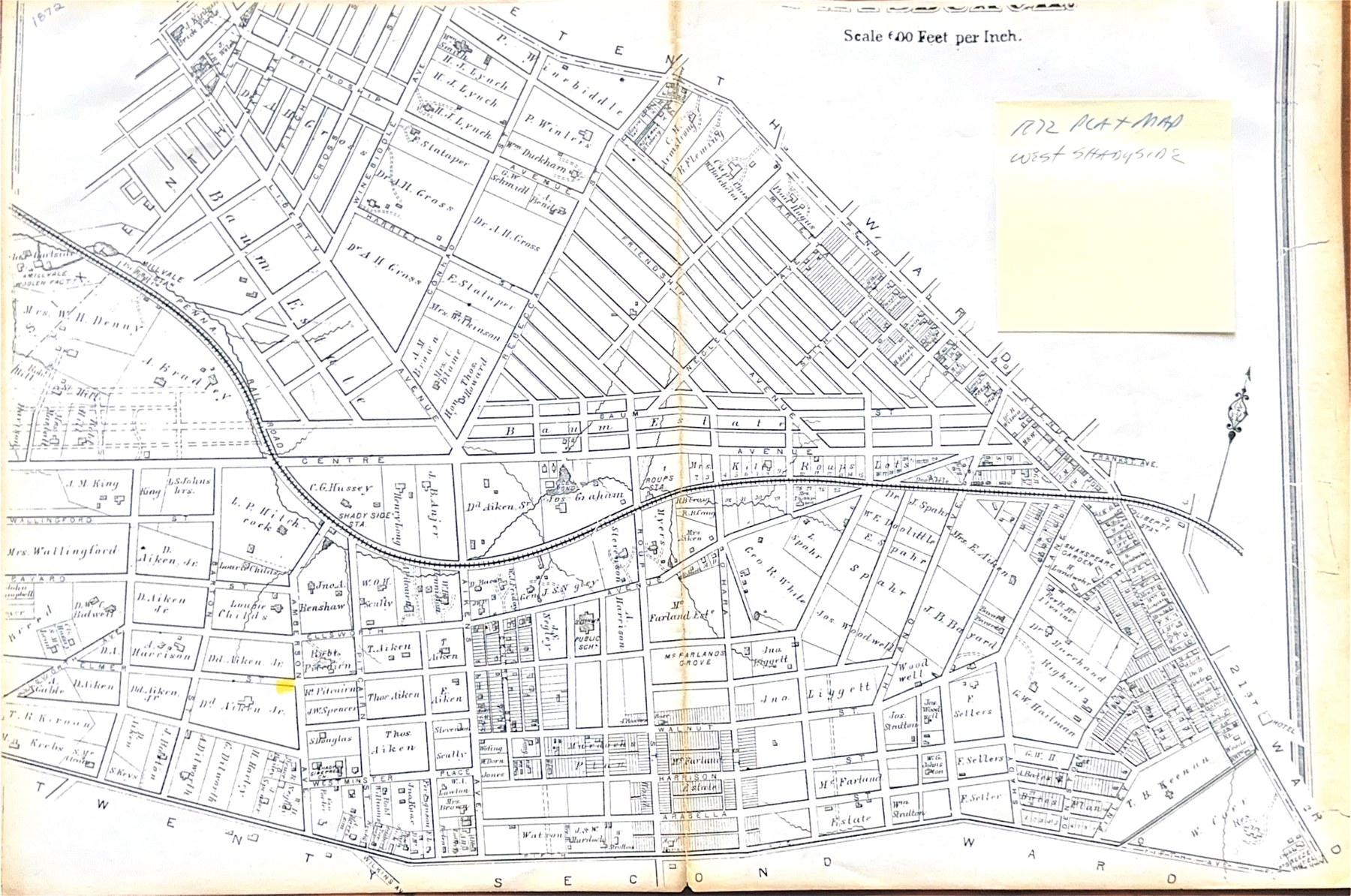
Shadyside, 1872. The neighborhood as it stood forty-one years before 704 Amberson was built — the Twenty-Second Ward of Pittsburgh, sparse roads, the Aiken family lands still largely intact. What would become Amberson Place had not yet been platted; the lot beneath this house was still part of the larger Aiken estate that Thomas Aiken had conveyed to his son David in 1854.
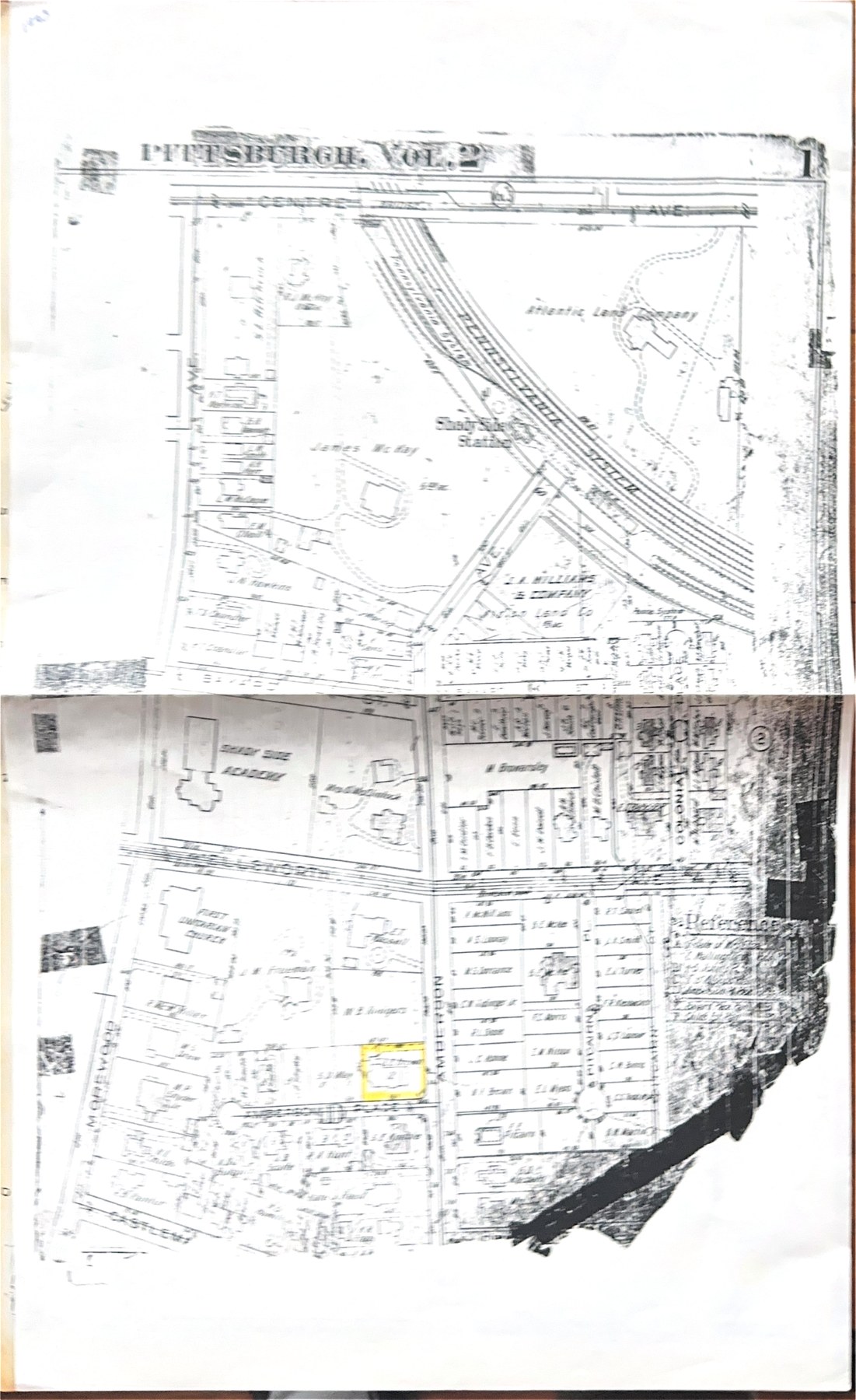
Hopkins atlas, "Pittsburgh Vol. 2," plate 1. Shadyside after the Aiken estate had been platted into Amberson Place. Lot 12 — 704 Amberson — is highlighted in yellow at the corner of Amberson Avenue and Amberson Place. The map shows Shady Side Academy still at its East End campus (relocated to Fox Chapel in 1922), Shady Side Station on the Pennsylvania Railroad's diagonal cut, and the Atlantic Land Company's holdings to the north. The covenants on the lot — single-family use, masonry walls, the 35-foot setback — were imposed by Callie Aiken when she sold to Lulu Brown in April 1913.
The architect: Edward Joseph Weber
704 Amberson was designed by Edward Joseph Weber (May 31, 1877 – c. 1968), a Pittsburgh architect who was, in the words of one critic, "one of America's premier regional ecclesiastical architects" before slipping into a long, half-forgotten second act. The house was an early commission — Weber was 36 — and it sits within the romantic, medieval-inflected idiom that would define his greatest work.
Weber was born in Cincinnati to Henry Weber, a German-immigrant shoe-store owner. His mother died when he was a toddler. As a child he filled sketchbooks with drawings of medieval buildings and Venetian canals — an early devotion to Old World form that would never leave him. He trained in Boston and studied at the École des Beaux-Arts in Paris, returning to the United States and settling in Pittsburgh, where he would spend the rest of his career. He was already accomplished by the time he designed 704 Amberson: in 1904 he had completed the synod hall and chancery for Saint Paul's Cathedral in Oakland; by 1913 his office sat in the Renshaw Building at 217 Ninth Street, downtown, and he himself lived at 4400 Centre Avenue in Schenley Farms. He worked variously under his own name and as a partner in Link, Weber & Bowes, the firm that would later design Central Catholic High School in Oakland.
What followed was the most productive period of his life. Through the 1910s and into the 1920s, Weber produced a body of medievalizing schools, churches, and houses across western Pennsylvania and West Virginia — among them St. Joseph's Cathedral in Wheeling (his masterpiece, restored in 1996 for $3 million), St. Colman's School and Convent in Turtle Creek, St. Mark's School in McKees Rocks, and the buildings of St. Scholastica's parish in Aspinwall. He published two nationally read books on ecclesiastical design and served two decades on the Pittsburgh Architectural Club. By the late 1920s he had married, fathered six children in seven years, and was at the height of his career.
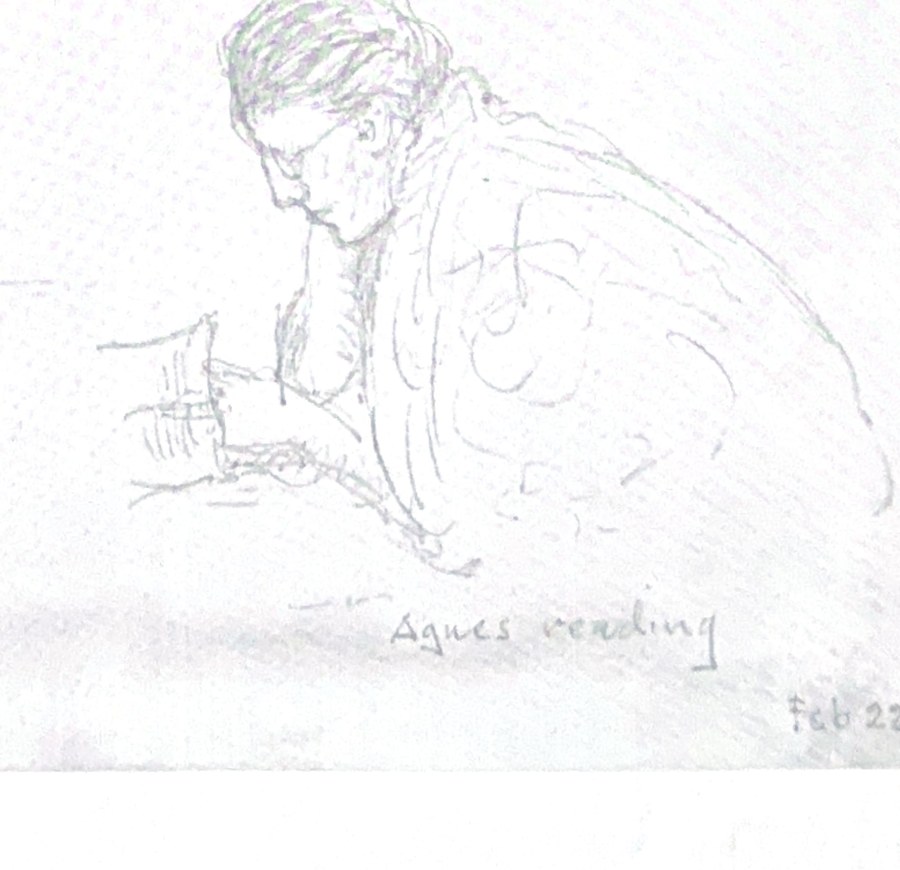
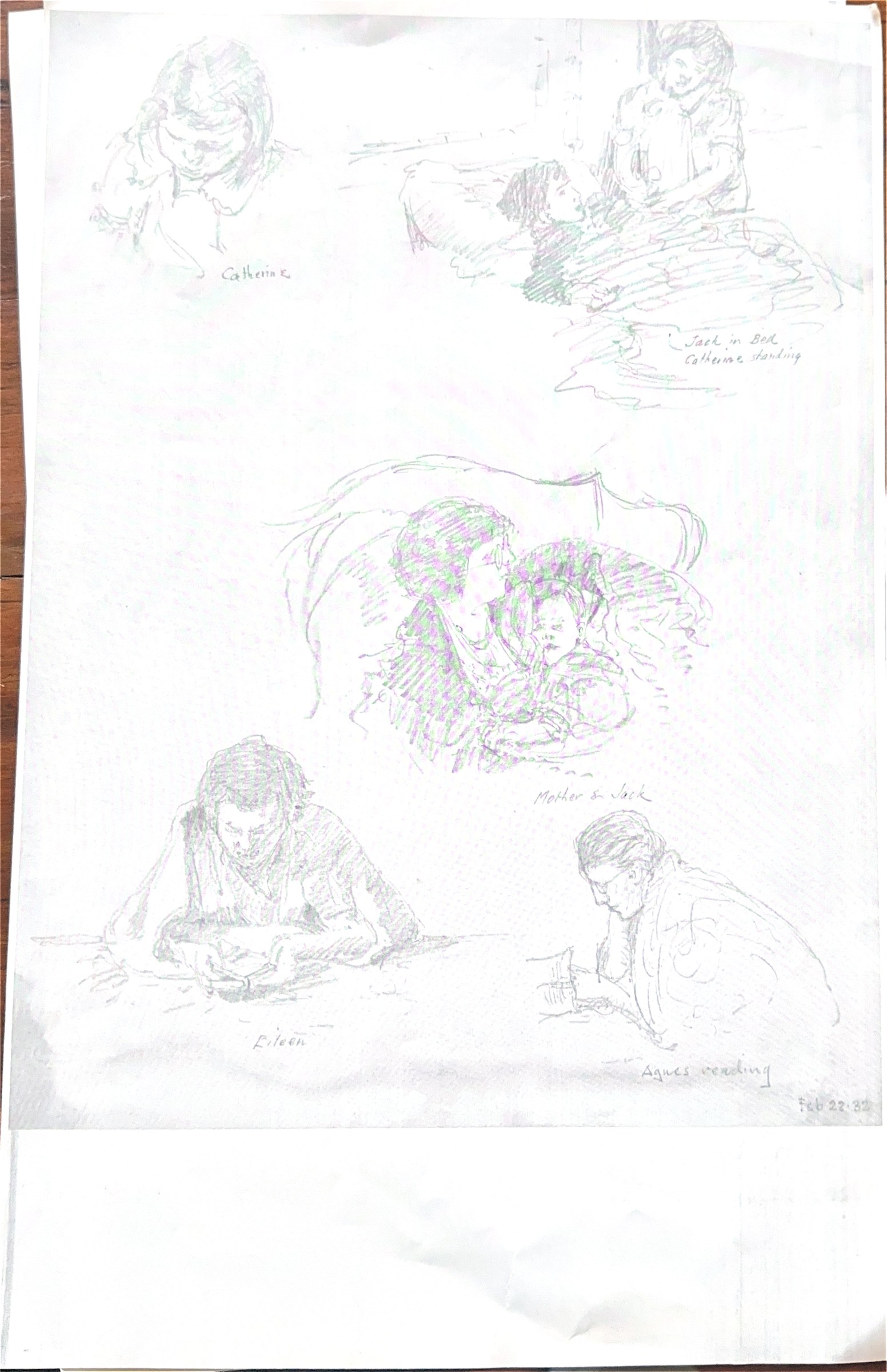
Agnes reading. Edward J. Weber, February 1932.
Then, with the Depression, it ended. As the Patricia Lowry profile in the Pittsburgh Post-Gazette of February 9, 1997 put it: "for reasons still unknown," Weber was separated from the firm that bore his name. The era of Catholic-parish expansion was over, and so was his career as one of America's leading regional ecclesiastical architects. The family lost their cherished East End home. He spent the last two decades of his working life in obscurity. His daughter Agnes Weber Floyd would later say that her father never spoke to his children about his buildings: "I think we were a distraction to him." The drawing at right is Agnes — drawn by him, on a Saturday afternoon, sixty-five years before that interview.
The Garden House comes from the better years. It is among Weber's earlier, smaller, more residential commissions, but it carries everything he cared about — the long stuccoed walls, the great chimneys, the heavy slate roof shaped to suggest thatch, the patient medievalism worn lightly. It is what one of America's premier ecclesiastical architects did when he turned, briefly, to a single family's house.
One year before the house: Carnegie Tech, 1912
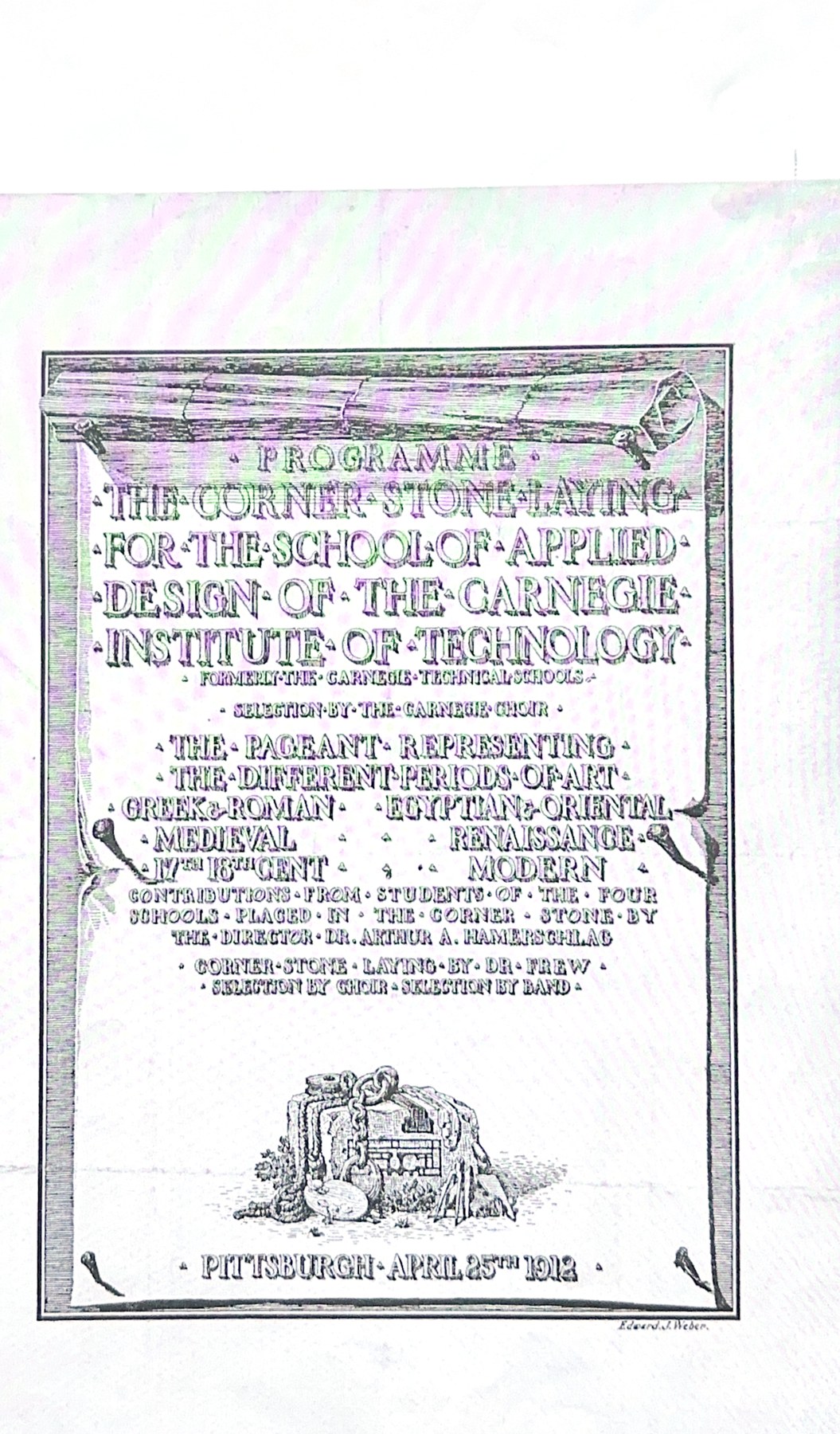
The clearest surviving sample of Weber's design hand — apart from the buildings themselves — is the cornerstone-laying programme he designed for the School of Applied Design of the Carnegie Institute of Technology (now Carnegie Mellon University), dated April 25, 1912. The cornerstone was placed by Dr. William N. Frew, the Pittsburgh philanthropist, with contributions from students of the four schools laid inside it by the institute's first president, Dr. Arthur A. Hamerschlag. The programme itself reads like a vow: a pageant representing the Greek & Roman, Egyptian, Oriental, Medieval, Renaissance, 17th–18th century, and Modern periods of art, with selections by the Carnegie Choir and the band.
The design is unmistakably Weber's: a gothic-medieval scroll, lettering hand-drawn in the manner of an illuminated manuscript, a vignette at the bottom of the cornerstone with mason's tools and laurel — the same medievalism, the same patience, the same affection for the past, that would appear in stone and stucco on Amberson Avenue exactly one year later.
Programme — The Corner Stone Laying for the School of Applied Design of the Carnegie Institute of Technology. Pittsburgh, April 25, 1912. Designed by Edward J. Weber (signature visible at lower right). Click for full size.
Weber the monument designer
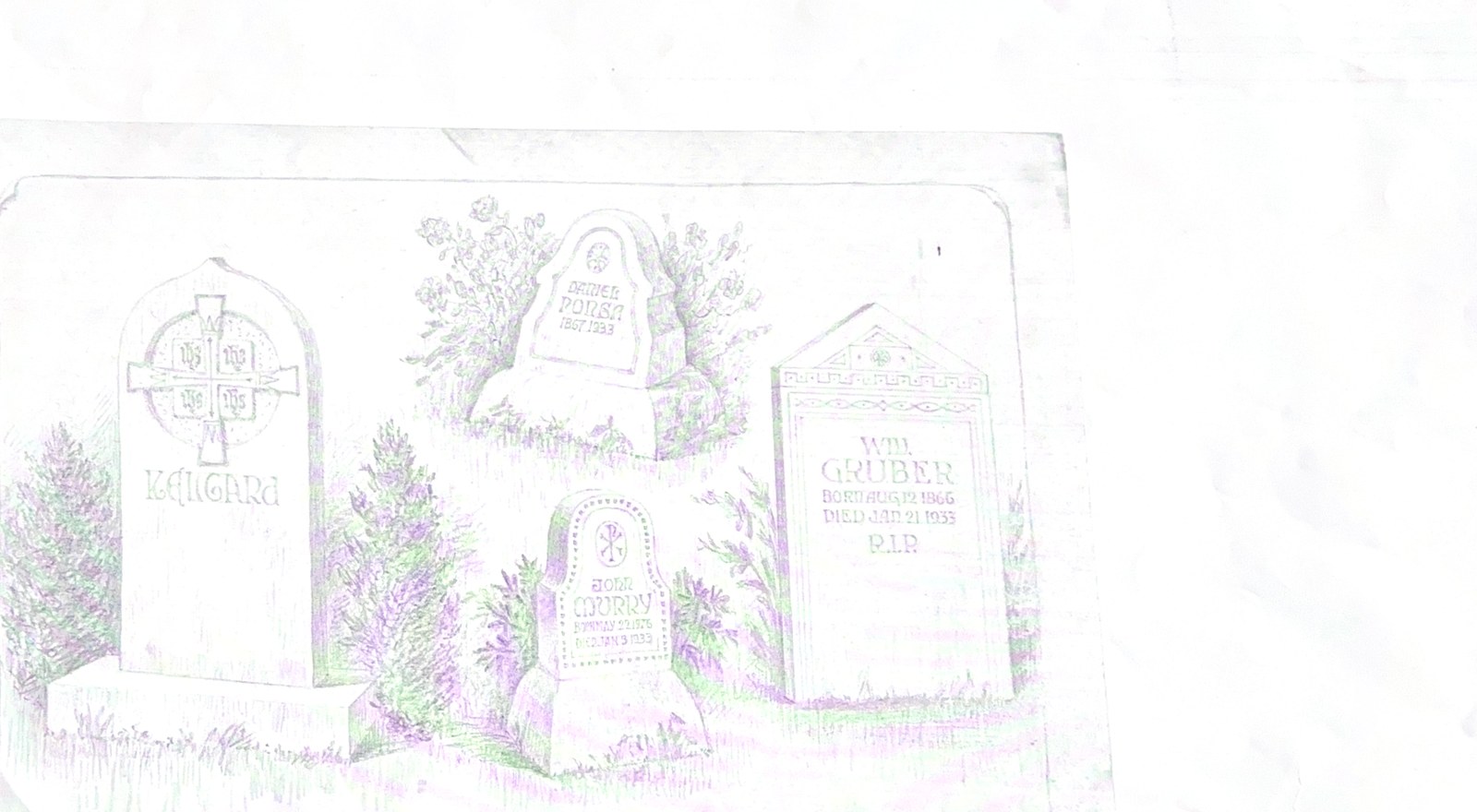
Less written-about than his churches and houses is Weber's work as a designer of cemetery monuments. The presentation drawing below — a single tableau showing four monument designs arranged in an idealized landscape — survives in the Garden House archive and is signed in the credit line at lower right, "Edward J. Weber Designer." Two of the names are legible (Kilgar and Gruber); the others are too soft to make out. The compositions are gothic and pediment-temple variants: Celtic-cross headstones, small gothic-arched markers, and a temple-front mausoleum, drawn with the same patience that shaped his church facades.
Cemetery monument designs, pencil presentation drawing by Edward J. Weber. Four monuments shown: Kilgar (Celtic cross, left), two unidentified gothic markers (center), and Gruber (temple-front, right). Date and patrons unknown. Click for full size.
Weber's hand
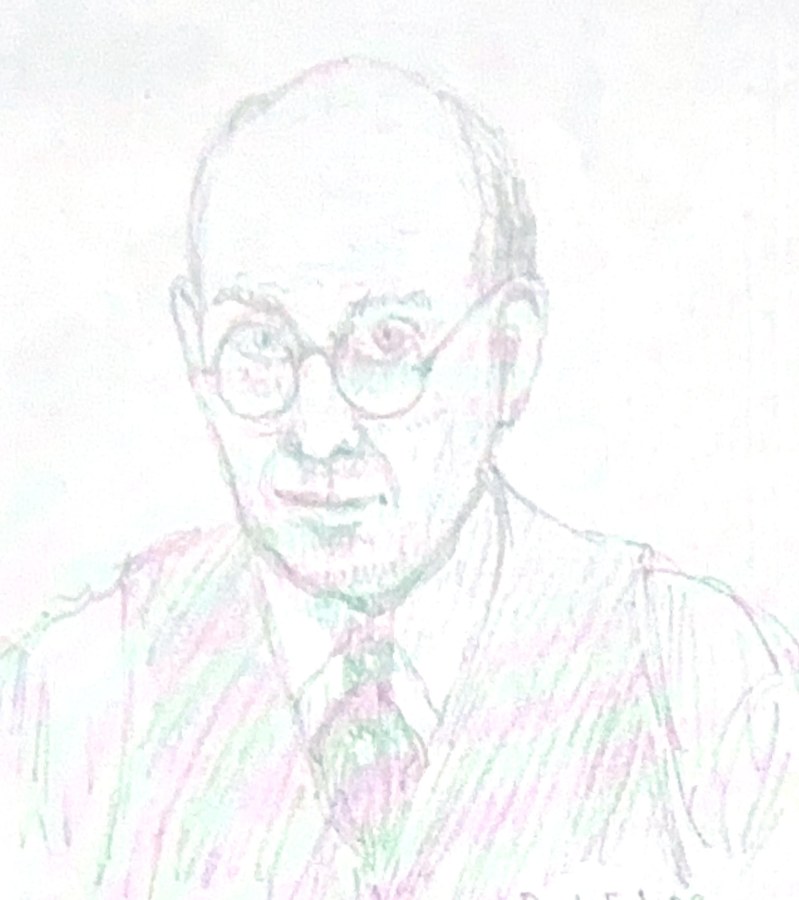
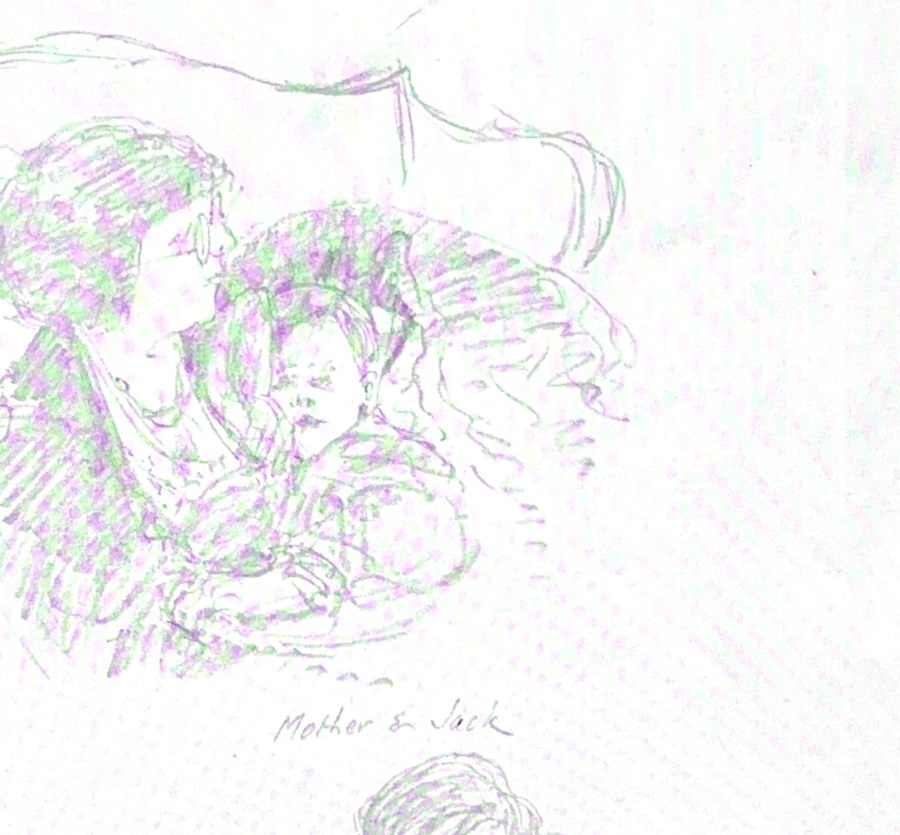
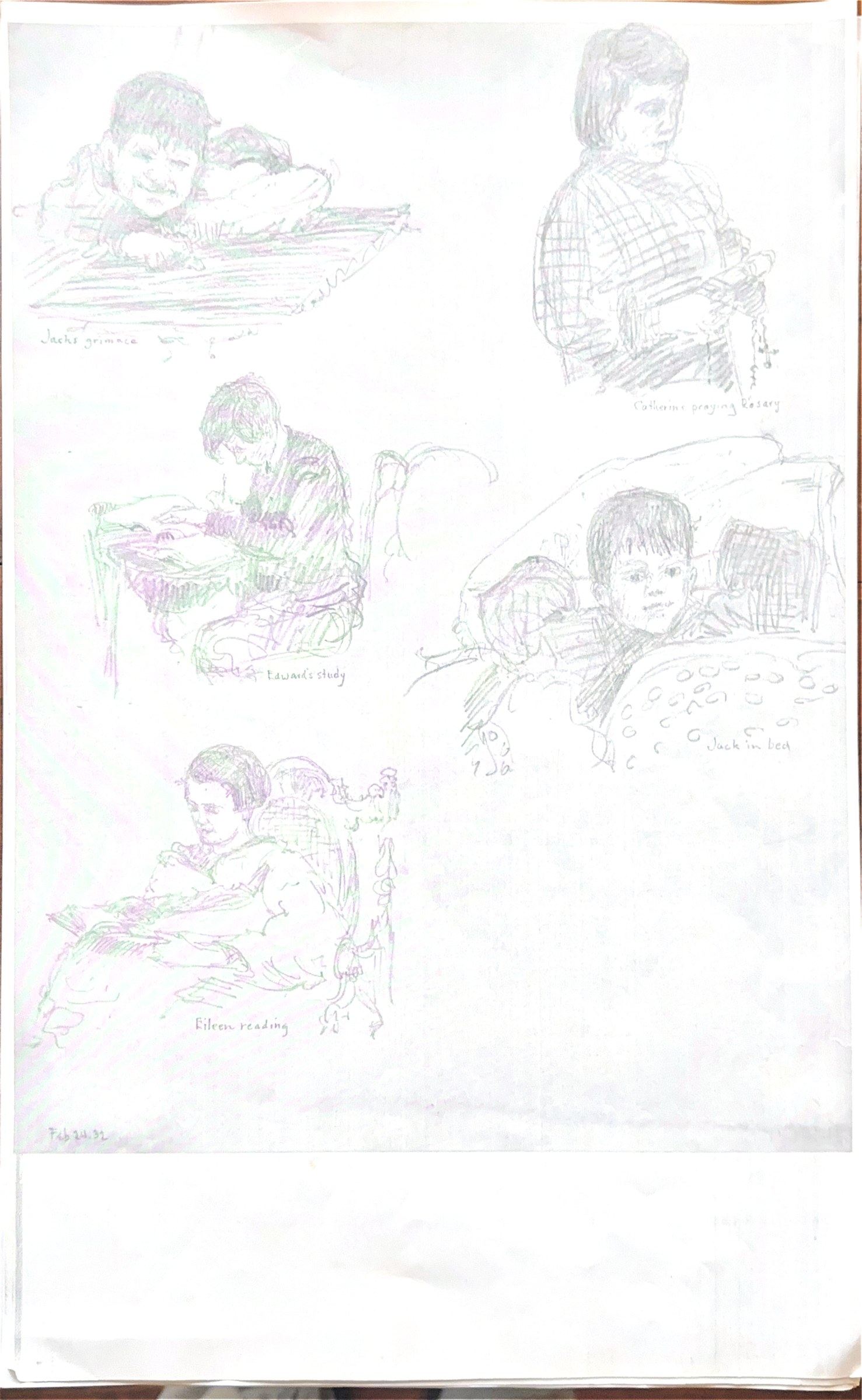
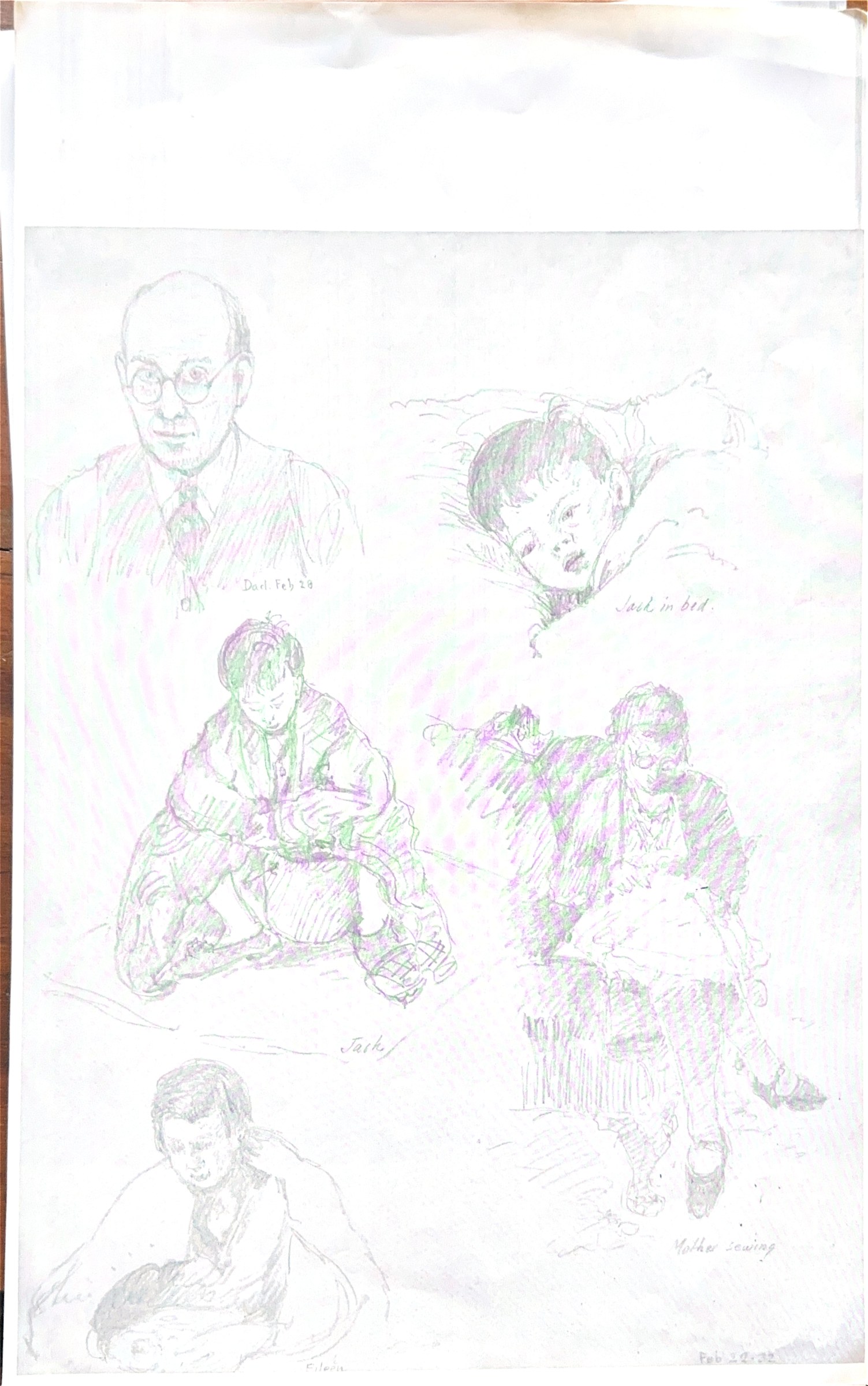
The Garden House archive holds three full sheets of pencil sketches Weber drew of his family in a single afternoon — Saturday, February 24, 1932. The household sat for him, room by room. He worked through them: Jack at the table making a face, Catherine with her rosary, Edward at his desk, Jack again in bed, Eileen reading, his wife sewing, the baby in her arms, his own father in his glasses, the children clustered together. Across the three sheets are something like fifteen separate studies, all dated to that one day, each labeled in his own light hand. They are intimate, attentive, careful. It is the architect at home, in the year his career was ending, drawing the people in front of him.
Two close-ups before the sheets:
Dad. February 24, 1932.
Mother & Jack. February 24, 1932.
And the three full sheets, in the order they appear in the archive:
Sheet 1. Jack's grimace, Catherine praying Rosary, Edward's study, Jack in bed, Eileen reading. Click for full size.
Sheet 2. Dad, Jack in bed, a seated child, Mother sewing. Click for full size.
Sheet 3. Catherine, Jack in bed with Catherine standing, Mother & Jack, Eileen, and Agnes reading. Click for full size.
Weber's gifts
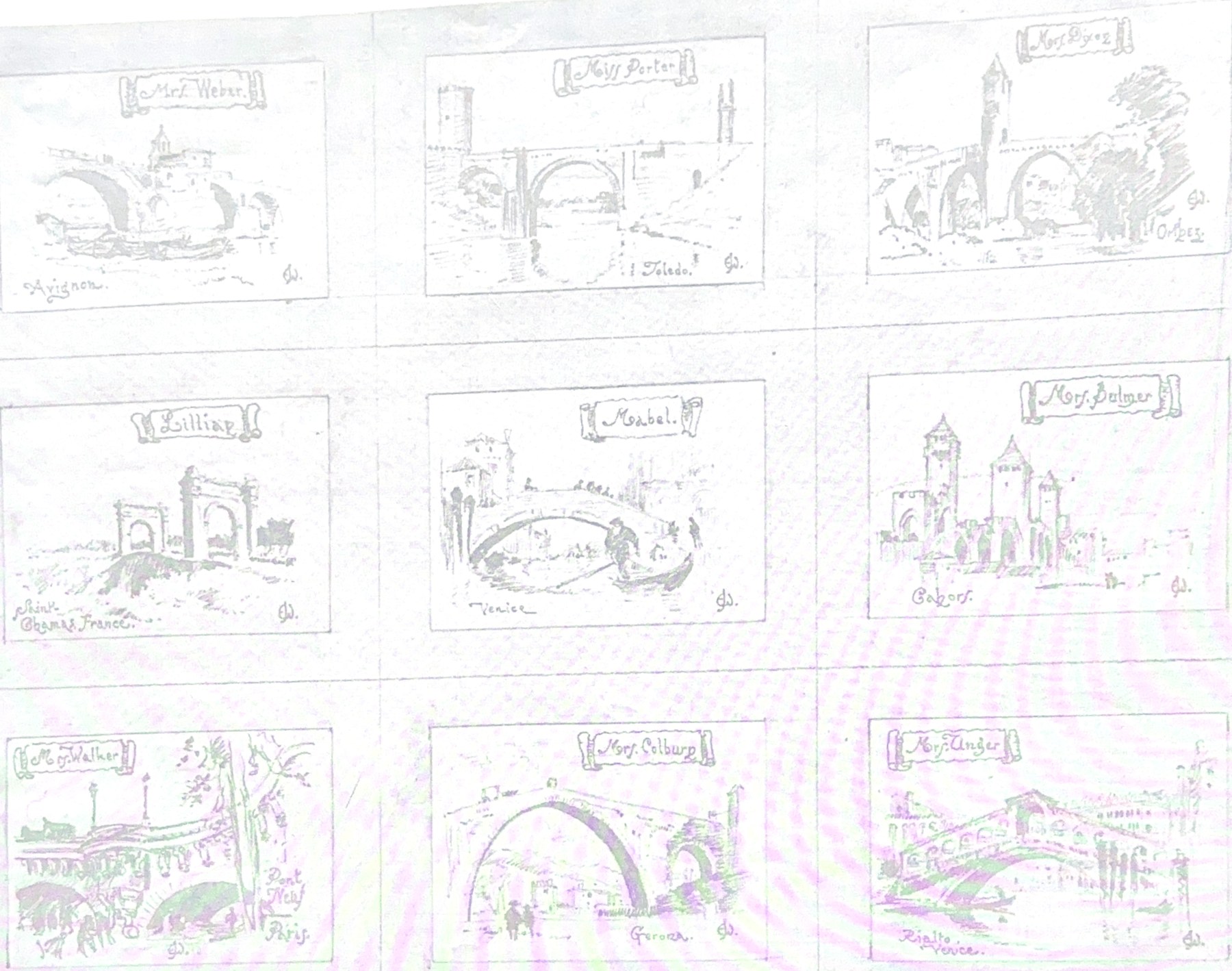
The page below is the closing piece of the Weber archive. Nine small architectural sketches, each in its own pencil-drawn frame, each with a recipient's name on a banner across the top — Mrs. Weber, Miss Porter, Mrs. Palmer, Lillian, Mabel, Mr. Walker, Mrs. Colburn, Mr. Unger — and each labeled at the bottom with a European subject he loved: Avignon, Toledo, Cahors, Saint-Chamond, Venice, the Pont Neuf in Paris, the Rialto. They are gift drawings, made for friends and family. The Pont d'Avignon is the one for his wife. The whole page is the Beaux-Arts–trained, Old-World-haunted architect of the Garden House at his most generous: making small, careful, beautiful objects to give away.
Weber's gift sketches. Pencil on paper, undated. Nine European architectural subjects dedicated to friends and family. Click for full size.
Sources for this section: the original 1996 research report on the house's history (in Documents); Walter Kidney, Landmark Architecture of Pittsburgh and Allegheny County (Pittsburgh History & Landmarks Foundation); Franklin Toker, Pittsburgh: An Urban Portrait; Patricia Lowry, "An Architect Out of Time," Pittsburgh Post-Gazette, February 9, 1997; "Architecture Around Us: Medieval Meets Modern in the Work of Edward J. Weber," Western Pennsylvania History (Penn State Press).
The roof — a Weatherbest thatch-effect
Walter Kidney described the Garden House's roof as one that "does not imitate, yet in its form implies, thatch." The technique behind that effect has a name. The roof is a Weatherbest Thatched Straw Effect Roof — a system of stained, curved red cedar shingles developed by the Weatherbest Stained Shingle Co. of North Tonawanda, New York, and patterned after the old straw roofs of English cottages. A 1928 Weatherbest installation manual lives in the house's reference library and is the single best document for any future roofer.
The technique is unmistakable once you know what to look for. Standard red cedar shingles are bent — by the manufacturer, before shipping — into precise radii so they can wrap around features that ordinary shingles can't: 20-inch radius for ridge caps and the curve at the eaves, 14-inch radius for hips and valleys, 10-inch radius for the rolls at the rakes. The flat shingles for the open roof faces have their butts sawn in a special "thatch" pattern so that, laid in irregular wavy courses with a 2-to-3-inch exposure, they read as the soft, beaten-down lines of straw. The rafters underneath are furred up about 5 to 6 inches midway between eaves and ridges — a deliberate hump — so the finished roof carries the gentle convex curve of an old English cottage rather than the flat plane of a modern roof.
The colors specified for the original system were "weathered straw" in three blended shades, with the option of a touch of dull red and brownish green to break the monotone. The shingles arrived from the factory pre-mixed in the right proportions; the carpenter laid them as they came from the bundle.
Two practical notes for whoever maintains this roof in the future. First: the system was designed for 20-plus years of life per coat, but the curved shingles cannot simply be replaced with off-the-shelf flat ones — the radii matter. Second: while the Weatherbest company itself is long gone, the system is well-documented and a competent slate-and-shingle contractor with the original installation book in hand can re-create it. The 1928 manual is digitized in the house's reference library, with full specifications, drawings of the rafter geometry, and the exact nailing schedule.
Source: Weatherbest Thatched Straw Effect Roofs: The Construction of Thatch Straw Effect Roofs with WEATHERBEST Thatched Stained Shingles, Weatherbest Stained Shingle Co., Inc., North Tonawanda, NY, 1928 (PDF in the house's documents archive).
In the literature: "The Two Pittsburghs"
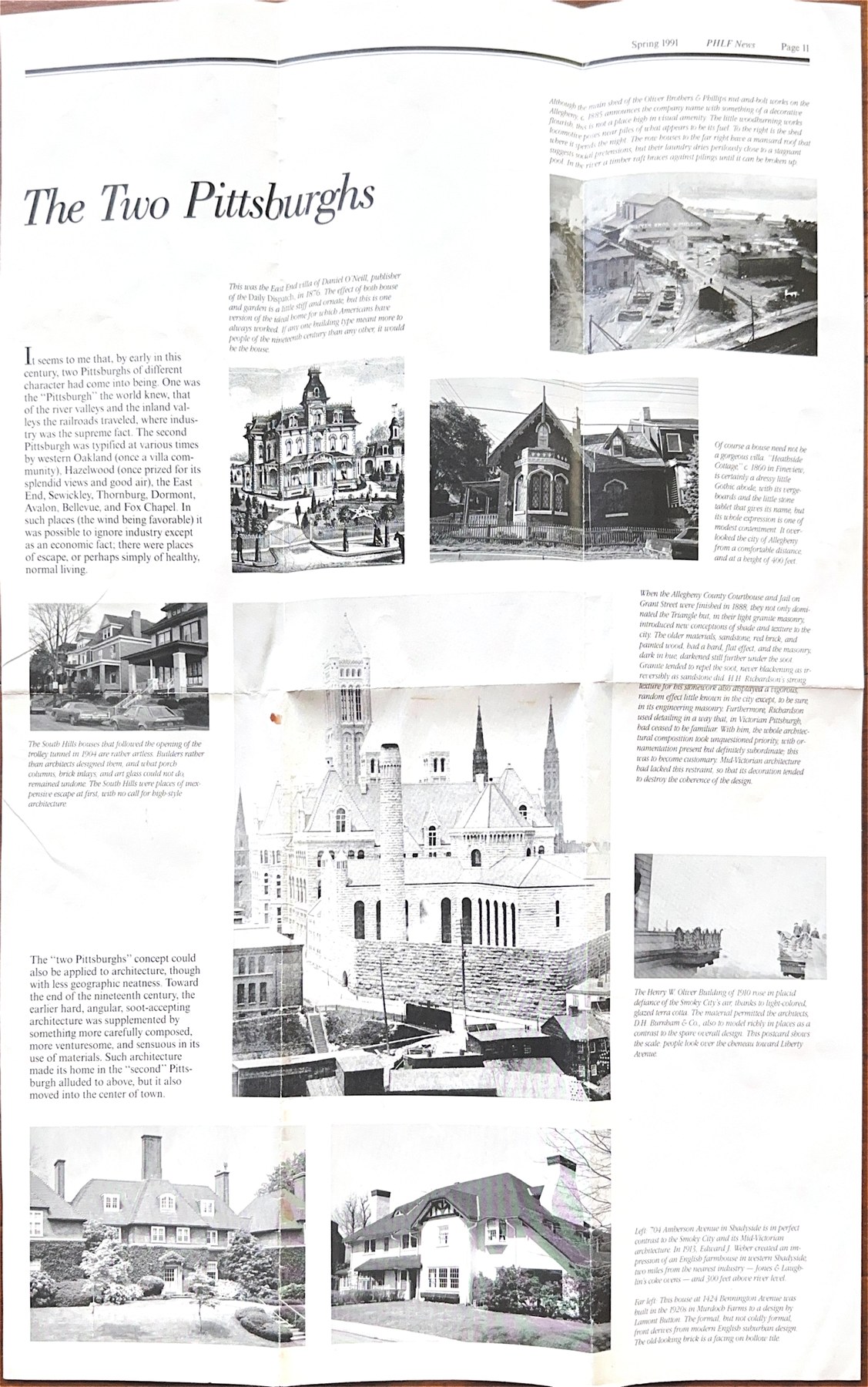
704 Amberson appears in PHLF News — the magazine of the Pittsburgh History & Landmarks Foundation — in the Spring 1991 issue, page 11, as one of the photographic exemplars of an essay titled "The Two Pittsburghs."
The article's argument: by the early twentieth century, two distinct Pittsburghs had come into being. The first was the city the world knew — the river valleys, the railroads, the supreme fact of industry. The second was the residential Pittsburgh of western Oakland, Hazelwood, the East End, Sewickley, Thornburg, Dormont, Avalon, Bellevue, Fox Chapel: places where, the wind being favorable, it was possible to ignore industry except as an economic fact. "Places of escape, or perhaps simply of healthy, normal living." The Garden House sits squarely inside the article's second category, and the photograph chosen to illustrate it is the front facade of 704 Amberson.
"The Two Pittsburghs."PHLF News (Pittsburgh History & Landmarks Foundation), Spring 1991, page 11. Click for full size.
The first family: Louis and Lulu Eaton Brown
The house was built for Louis Brown (b. December 22, 1861, New York City) and his wife Lulu Eaton Brown (b. June 1872, New York State), in the year Louis became president of the Oil Well Supply Company. They had been married since 1890. They had one child, Margaret, born the year after.
Louis was raised and educated in Oswego, New York. He was hired by an iron firm in New York City at seventeen, sent to Germany on its behalf at nineteen, and arrived in Pittsburgh in 1889 at age twenty-eight as assistant manager of the National Tube Company's local office. Within a year he had met Lulu Eaton — daughter of John Eaton, the founder and president of the Pittsburgh-based Oil Well Supply Company. They married in 1890 and lived for the next twenty-three years in the Eaton family home at 705 Devonshire Street, a block north and east of Amberson. Louis joined his father-in-law's firm as second assistant treasurer in 1891, rose to treasurer in the 1890s, and in 1911 — after John Eaton's death — became its president.
The move to 704 Amberson followed two years later. Lulu purchased the lot in April 1913; the building permit was issued that September; the house was occupied within months. The 1920 census lists three live-in servants in residence: a cook, a maid, and a butler — Emanuel Yuon, who had followed the family from the Devonshire Street house. The Browns lived here, in this house Weber built, until their deaths within nine months of each other: Lulu on August 12, 1929; Louis on May 2, 1930.
Their daughter Margaret had moved away by then, to Pasadena, California. The house stood empty for the next fifteen years — through the worst of the Depression and all of the Second World War — until Margaret sold it in June 1945.
The covenants on the lot
Callie J. Aiken's 1913 deed to Lulu Brown contained restrictions that shaped the house — and the block around it — for the next hundred years. Worth knowing for anyone who lives here.
Single-family use only.
Exterior walls of brick, stone, or cement, or a combination — with a minimum cost of $10,000.
A 35-foot setback from Amberson Place (porches, verandas, bow windows, and eaves excepted).
Any garage to be set back at least 65 feet from the center line of Amberson Place, for private family use only.
No stables. No horses, no cows.
Easements reserved by the Aiken estate for the maintenance of electrical and telephone wiring and water and gas piping.
These covenants were the mechanism by which the Aiken family ensured that the new houses on the subdivided estate "complemented existing structures in the Amberson Avenue area." They are why the block looks the way it does.
The chain of stewards
From Louis and Lulu Brown to the Crivella family — every owner of 704 Amberson Avenue, with the deed dates and prices.
1913 — 1929/1930
Louis & Lulu Eaton Brown. Built and lived here. Lulu died Aug 12, 1929; Louis May 2, 1930. House purchased April 14, 1913 (DBV 1778, p. 170; lot $33,000, construction $27,500).
1930 — 1945
Vacant. Inherited by their daughter Margaret Eaton Brown Fleming, who had moved to Pasadena, California. The house stood empty through the Depression and the war.
1945 — 1953
Roger M. & Helen D. Blough. Purchased June 13, 1945 from Margaret Eaton Brown Fleming for "$1 and other valuable considerations" (DBV 2835, p. 436). Roger Blough went on to become the chairman and CEO of U.S. Steel from 1955 to 1969 — one of the most consequential American industrialists of the postwar era. He was living in this house during his rise.
1953 — 1966
J. Everett & Mary C. McClenahan. Purchased March 2, 1953 for $40,000 (DBV 3247, p. 716).
1966 — 1982
George H. & Janet B. Tabor. Purchased June 3, 1966 for $69,000 (DBV 4183, p. 422).
1982 — 1990
Edward L. & Marilyn M. Dardanell. Purchased May 12, 1982 for $300,000 (DBV 6471, p. 549).
1990 — 2003
William M. & Suzanne M. Steitz. Purchased February 28, 1990 from Edward L. Dardanell (after a $1 transfer earlier that day from Edward and Marilyn jointly to Edward solo; DBV 8198 p. 378 and DBV 8199 p. 450).
2003 —
Arthur R. & family. Purchased September 22, 2003 for $1,181,725. The professional w466968_* photographs in the archive are from the 2003 listing — they show the house as the Steitz family had kept it. Subsequent renovations and the garden development that earned the house its current name are chronicled below.
Source materials: The 1996 ownership-history research report (commissioned by a previous owner; full text in Documents). Allegheny County Recorder of Deeds records. Pittsburgh city directories. U.S. census records 1900, 1910, 1920.
How it became The Garden House
When did neighbors start using the name "The Garden House"? Tell that story here, in a few sentences.
A few sentences on what makes the gardens distinctive — the species, the layout, the rhythm of bloom from March through October.
Garden — spring
Garden — summer
Garden — fall
Garden — winter
Renovations & changes
A timeline of the major work done to the house — what was changed, what was preserved, and why.
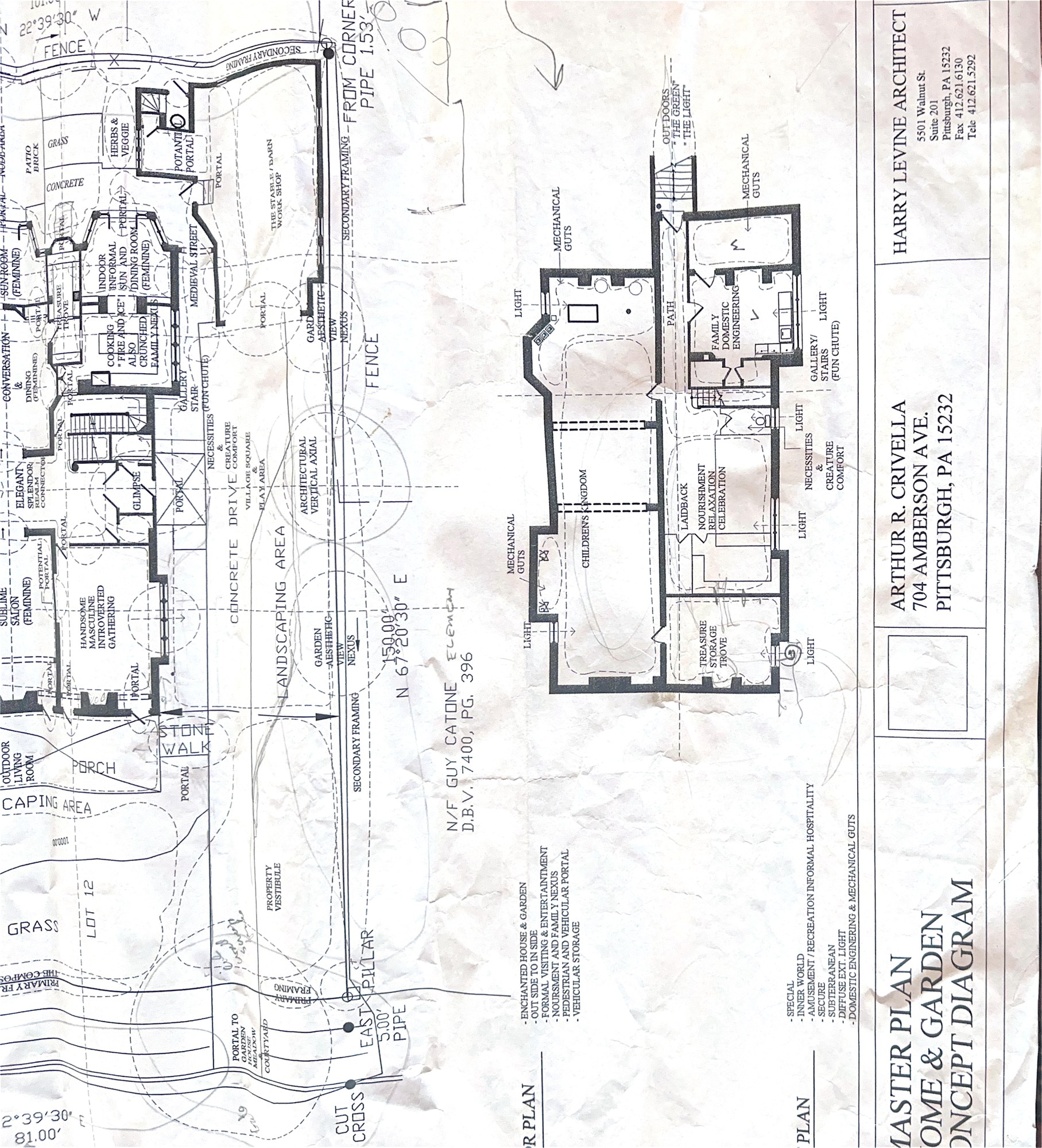
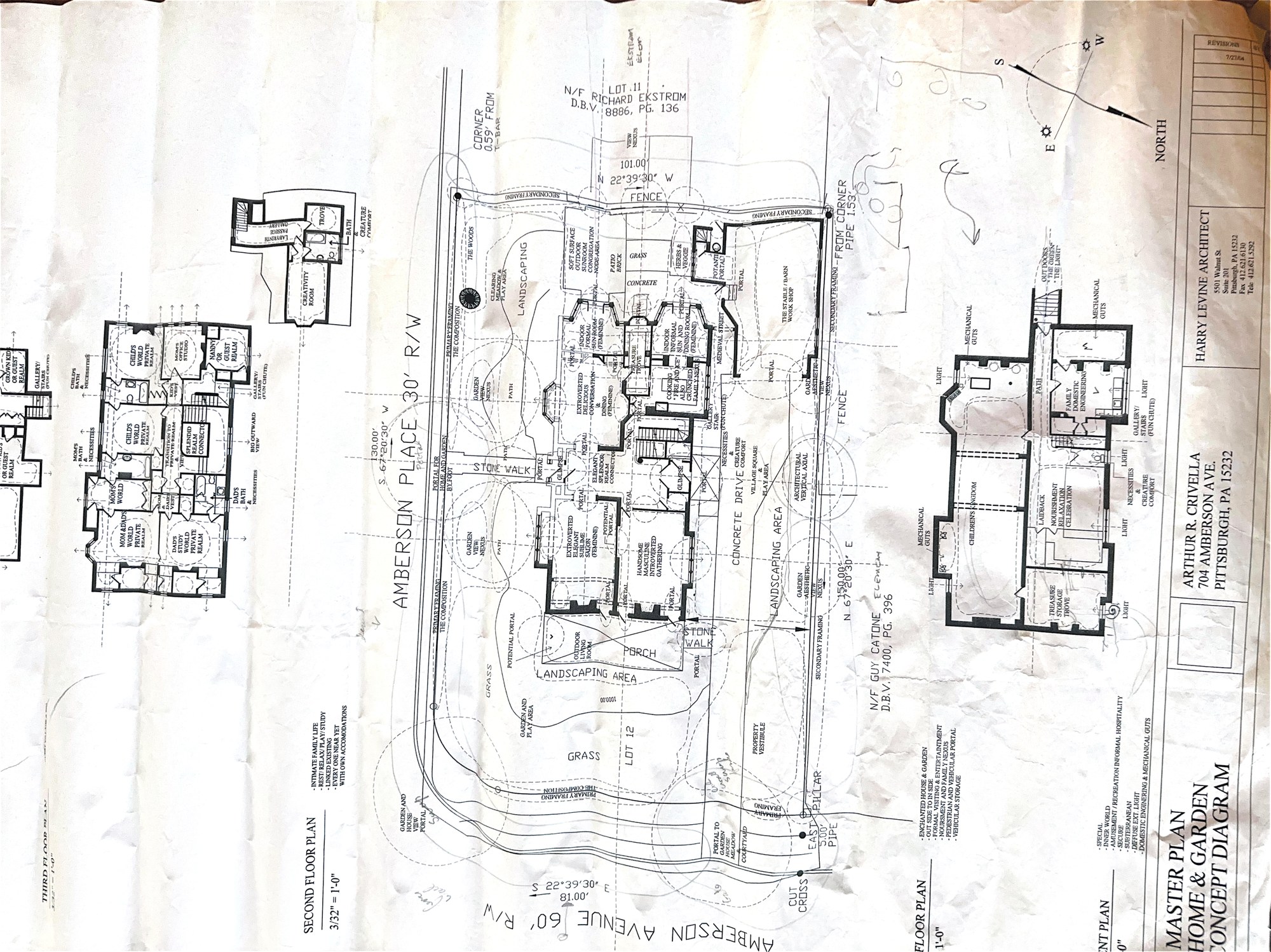
The Levine master plan
A "Home & Garden Concept Diagram" produced by Harry Levine, Architect (5301 Walnut St., Suite 201, Pittsburgh PA 15232) for the Crivella renovation. Two drawings on one sheet: the site plan with the full Lot 12, fences and lot lines, neighbor reference (N/F Guy Catone, D.B.V. 7400, p. 396), and the labeled garden zones — Enchanted House & Garden, Garden Shed, Children's Portal, Vehicular Storage; alongside a floor plan of the house with the room-by-room program (Mechanical, Bath, Gallery, Stair, Domestic Engineering, etc.). It is the document of intent for the work that became the Garden House as it stands today.
Master Plan — Home & Garden Concept Diagram (concept sheet). Harry Levine, Architect, Pittsburgh. Year TBD. Click to view full size.
Master Plan — Home & Garden Concept Diagram (detailed sheet). Three drawings on one sheet: Second Floor Plan (top left, 3/32" = 1'-0"), detailed site plan (center) with Amberson Place 30' R/W, Amberson Avenue 60' R/W, and neighbor parcels (Ekstrom, Catone), and First Floor Plan (right). Click to view full size.
Restoration evidence — the fence
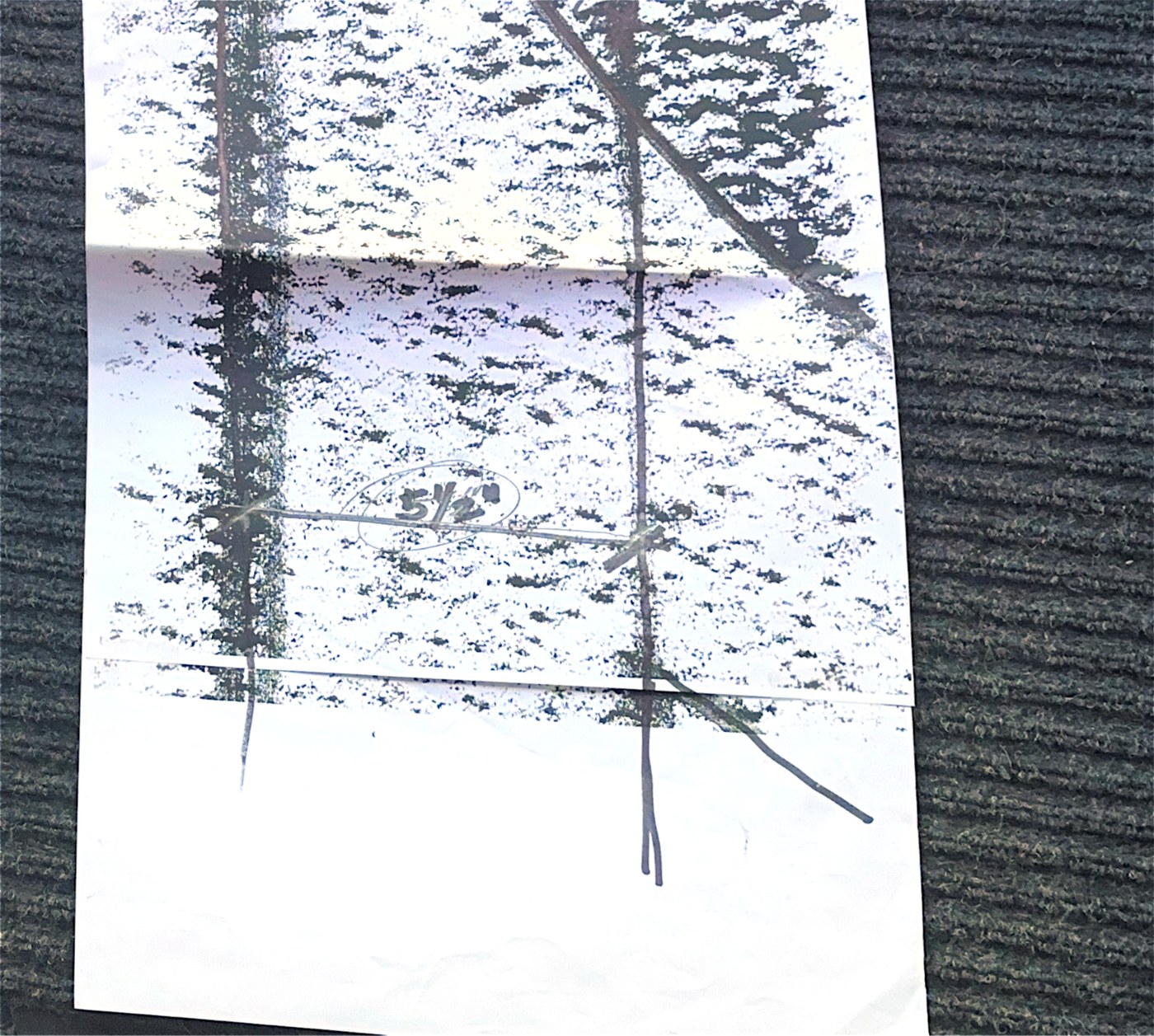
Where there was no surviving original, the restoration worked from the historical photographs themselves. The fragment below is a blowup of a fence detail taken from one of the period photos in the archive. Measurement lines were drawn across known features, and a single dimension — 5½ inches — was used as the reference scale to back-calculate the spacings, post heights, and finial sizes of the original fence. The kind of working document that doesn't normally survive a project, but that explains why the rebuilt fence sits where it does.
Fence-detail blowup with 5½" reference measurement. Used to estimate original fence dimensions from a period photograph during restoration.